

I had always shown an ability to draw. Drawing was one of those skills which fellow pupils often admired - a bit like being good a football or cricket and this ability undoubtedly improved one’s street cred! In 1962 I was in what is currently known as year 10, starting GCE “O” level courses, including Art. I had a modicum of talent but the Art teaching during this year was of low quality and rather pedestrian. I was not engaged. Jan Thorn became the Art teacher at my school in 1963 and within a short time of his arrival he transformed my experience. I became utterly obsessed with Art and in addition to normal Art lessons I spent all my spare time in the Art Room, always there after school until late. Above all Jan encouraged me to paint, and particularly to observe and connect with the visual world. My knowledge of the use of colour and tone developed rapidly and my ability to respond spontaneously and directly, in paint, improved dramatically. The amount of work I did was significant - my only regret is that none of it survives.
Besides my debt to Jan, who sadly died in 2009, I also owe a huge debt to the Headmaster of the school, John Dodds. He had the vision to appoint Jan and he went to every length to encourage the development of the Arts in his school. In todays world where secondary schools have been pressured into devoting more time to core subjects, such as English Maths and Science, the Arts have been significantly marginalised to the extent that Art, Music and Drama in state schools in England are in rapid decline.
From school I attended Chesterfield College of Art (1963-64) where I completed a foundation course before applying to higher education. Don Wilkinson was the lecturer in printmaking and he inspired in me an interest and a love of printmaking which remains with me today.
From 1964 - 1967 I attended Sheffield College of Art to study painting and printmaking. Just previous to this a major review of Art School Education in England and Wales, resulted in the Coldstream Report, authored by the Artist Sir William Coldstream. Until then well over 100 provincial art schools offered a two tier qualification in a range of art disciplines - 2 years Intermediate followed by 2 years NDD - National Diploma in Design. After reorganisation the number of colleges offering, what became, a first degree qualification was reduced to less than 30, of which Sheffield Art College was one. The new qualification was called The Diploma in Art and Design (Dip.A.D, eventually to be re-designated as a B.A. hons. degree.) My year was the first cohort to gain this new qualification.
The photograph below shows me at work in one of the dedicated 3rd Year Studios at Sheffield, together with another student Grace Akari. We had a privileged existence. Throughout the final year students had exclusive use of two studios so that they could work without interruption. Students were also given an allocation of materials particularly canvas and stretchers and a tutorial team lead by Robin Plummer (Senior Lecturer in Painting) providing ongoing support and constructive criticism.
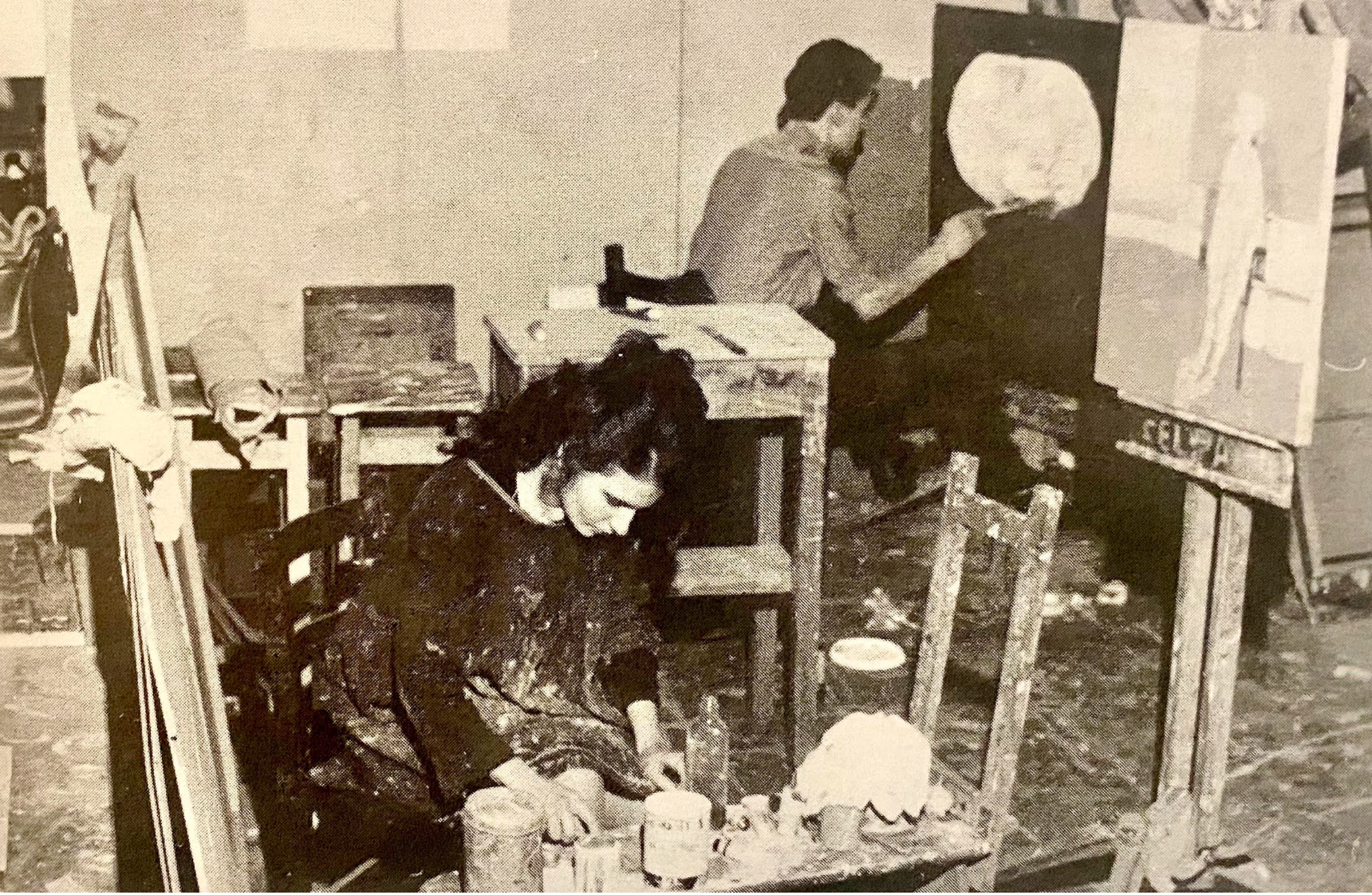
The source of this photograph is interesting. I happened to visit - quite by chance - the Mappin Art Gallery in Sheffield - probably late 1980’s early 90’s where I picked up a booklet produced for an exhibition called Generations Apart - A History of Fine Art Education in Sheffield. To my surprise it contained this photograph.
After Sheffield 1967 - 68 I attended Leicester Polytechnic (Later part of De Montfort University) Specialist Art Teacher Training Course to complete a PGCE. This was followed by a teaching career of almost 30 years.
My first teaching post (1968-72) was in Derbyshire at the Frederick Gent School South Normanton. The Head of Art was Ken Holland to whom I owe a huge debt, Ken was always supportive and encouraging and allowed me the freedom to develop my own ideas. Initially I found teaching very challenging and without Ken’s support I may well have given up. The school was run on rather draconian lines. In this school the Arts - other than the brass band - were not celebrated and the Art Department was seen as the place to dump children of low academic ability. Yet despite this, under Ken’s guidance, the Art department flourished and the standards were high.
In 1972 I obtained a job at the Melton Mowbray College of Further Education, By the end of my time at Melton I had developed a good printmaking department with particular emphasis on screen printing and etching. My major achievement was to persuade the engineering department to build me nd etching press, and my contact with Don Wilkinson was particularly helpful.
In 1977 I became Head of Art at Long Eaton School and I remained there until 1995 when I took early retirement. The stand out achievement at Long Eaton was my collaboration with the Head of Drama - Andrea Ellis. We developed an integrated Arts curriculum with particular emphasis on theatre design
and drama. This course was facilitated by an imaginative Curriculum Deputy Head with the result that many pupil obtained GCSE qualifications in Drama and Art. Many pupils were enrolled on this course from other schools at the beginning of year 10 and they were known as LEAP students (Long Eaton Arts Project).
As time went on I became more and more involved in the development of cross curricular initiatives which were fostered by Bob Boaden, Long Eaton School’s inspirational Curriculum Deputy, and by the end of my career in education I occupied the position of Senior Teacher and I eventually taught less and less Art.
Throughout my career I had always found time to make Art. The time at Melton Mowbray was particularly productive and there are some works in the exhibition that date from this period. But by far the majority of the work in the exhibition dates from the time after I had left full-time work. I am particularly pleased with the many prints in the exhibition and the way I use an inkjet printer to layer colour and surface by passing prints through the printer a number of times thus building complexity of surface and depth of colour.
In reviewing my work over the past 50 years or so I have become aware that there are common themes which appear time and time again - particularly landscape, and the place of trees in landscape. I have found the task of bringing my work together an interesting and illuminating experience.
Alf Allfree March 2026